AI Sales Automation & Business Growth Systems for SMEs in Singapore

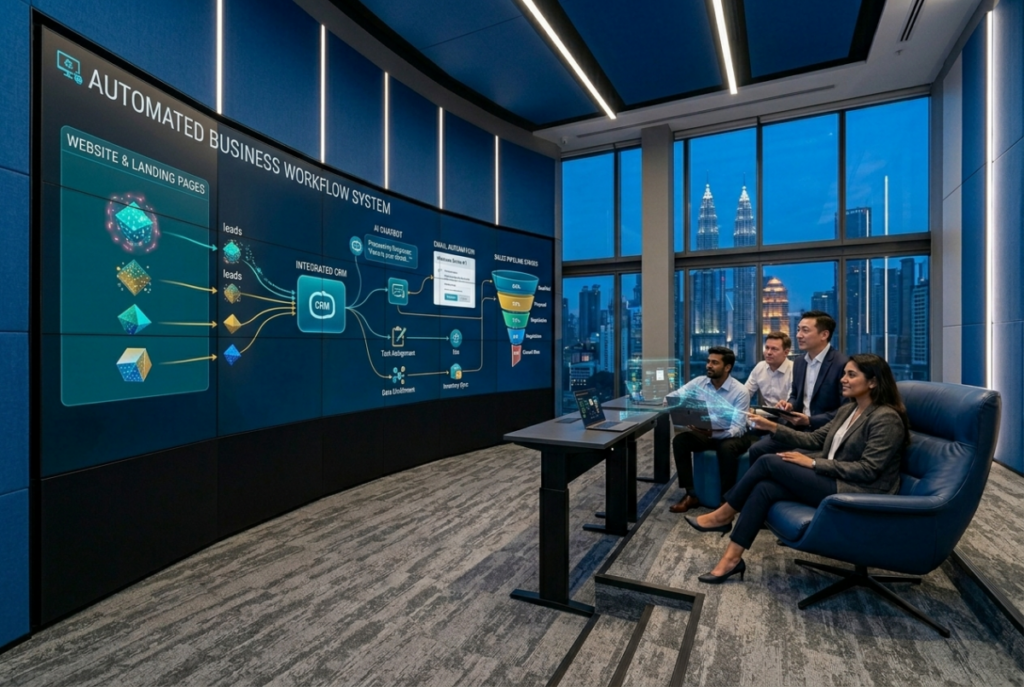
Introduction: The Shift From Manual Sales to Intelligent Business Systems
Modern businesses are undergoing a major transformation in how they generate leads, manage customers, and close sales. Traditional methods such as manual cold calling, scattered spreadsheets, and delayed follow-ups are no longer enough to compete in fast-moving markets like Singapore and Southeast Asia.
Businesses today face three major challenges:
- Rising cost of manpower
- Increasing competition across digital channels
- Faster customer expectations for response and service
To solve these challenges, companies are moving toward integrated AI-driven business systems that combine websites, CRM, automation, and intelligent lead handling into a single ecosystem.
This approach does not just improve efficiency—it fundamentally changes how businesses scale.
Instead of hiring more staff to handle more leads, companies are now building systems that handle growth automatically.
1. The New Business Model: Systems Over Manual Effort
A modern growth system is not just a website or a CRM. It is a connected digital ecosystem that manages the entire customer journey.
A complete system typically includes:
1.1 Lead Capture Layer
This is where potential customers enter the system:
- Website enquiry forms
- Landing pages
- Chatbots
- Ads and campaigns
The goal is simple: capture interest immediately and structure it into usable data.
1.2 Lead Intelligence Layer
Once a lead is captured, the system begins processing:
- Categorising enquiries
- Understanding customer intent
- Prioritising leads based on urgency or value
This replaces manual filtering and guesswork.
1.3 Engagement Layer
Instead of waiting for sales staff to respond manually, automation systems:
- Send instant replies
- Provide relevant information
- Trigger follow-ups
This ensures no lead goes cold.
1.4 Conversion Layer
At this stage, AI and CRM systems:
- Schedule meetings
- Route leads to sales staff
- Track deal progress
- Remind follow-ups
This structure ensures consistency and prevents missed opportunities.
2. AI Sales Automation: How It Works in Real Business Environments
AI sales automation refers to systems that help businesses automate outreach, engagement, qualification, and follow-up processes.
A typical workflow includes:
Step 1: Lead Generation
AI systems help businesses:
- Identify potential customers
- Segment audiences
- Generate outbound prospect lists
This replaces manual prospect research.
Step 2: First Contact (Automated Outreach)
AI can initiate engagement through:
- Email outreach
- Voice calls
- Chat interactions
The purpose is not to replace sales teams but to filter and qualify interest at scale.
Step 3: Qualification
AI systems ask structured questions such as:
- Budget range
- Service interest
- Timeline
- Decision-making authority
This ensures only serious leads reach human sales teams.
Step 4: Follow-Up Automation
One of the biggest sales problems is missed follow-ups.
AI solves this by:
- Sending reminders
- Re-engaging inactive leads
- Updating CRM records automatically
Step 5: Sales Handover
Qualified leads are passed to human teams with:
- Full conversation history
- Lead scoring
- Suggested next actions
This allows sales staff to focus on closing deals instead of chasing information.
3. Why Traditional CRM Systems Are No Longer Enough
Traditional CRM systems are useful for storing data—but they often rely heavily on manual input.
Common limitations include:
- Leads not updated in real time
- Sales reps forgetting to log interactions
- No automation in outreach
- Weak follow-up discipline
Modern AI-enhanced systems solve these issues by:
- Automatically capturing lead interactions
- Generating summaries of conversations
- Suggesting next actions
- Triggering automated workflows
This turns CRM from a passive database into an active sales engine.
4. AI in Small Business Growth: Equalising the Playing Field
One of the biggest advantages of AI systems is how they help small and medium businesses compete with larger organisations.
Instead of hiring large teams, SMEs can now:
4.1 Operate 24/7
AI systems never sleep:
- Respond to enquiries instantly
- Handle after-hours leads
- Maintain consistent communication
4.2 Scale Without Hiring
Businesses can increase:
- Lead volume
- Customer interactions
- Sales outreach
Without increasing headcount.
4.3 Reduce Missed Opportunities
Most businesses lose sales due to:
- Slow response times
- Missed follow-ups
- Lack of tracking
Automation ensures every lead is accounted for.
5. AI Cold Calling and Automated Outreach Systems
Outbound sales remains important, especially for B2B industries.
Modern systems now use AI to:
- Make structured outbound calls
- Introduce products/services
- Ask qualification questions
- Route interested prospects
This improves efficiency by removing repetitive manual calling tasks.
Human sales teams then focus only on:
- Warm leads
- Qualified prospects
- High-value conversations
This creates a more productive sales pipeline.
6. AI Email Automation for Sales Efficiency
Email remains one of the most critical sales communication channels.
AI-enhanced email systems can:
- Analyse incoming enquiries
- Draft professional replies
- Send brochures and materials
- Suggest meeting scheduling
- Trigger follow-up sequences
This reduces response time from hours to seconds.
Faster response = higher conversion rates.
7. Website as a Sales Engine, Not a Digital Brochure
A modern business website is no longer just for information—it is the front door of the sales system.
A high-performing website should:
- Capture leads effectively
- Guide users through structured funnels
- Connect directly to CRM systems
- Trigger automation workflows
Instead of simply displaying information, the website becomes an active participant in generating revenue.
8. Business Systems Integration: The Real Competitive Advantage
The strongest business advantage comes from integration.
A connected system ensures:
- Website → CRM → Sales pipeline → Follow-up → Conversion
Everything flows seamlessly without manual intervention.
Key integrations include:
- CRM systems
- Email platforms
- WhatsApp communication tools
- Internal dashboards
- Reporting systems
When these systems work together, businesses gain full visibility over their operations.
9. Industry Use Cases
9.1 Service Businesses
- Faster enquiry response
- Automated appointment booking
- Lead qualification before human follow-up
9.2 Manufacturing & Industrial
- Structured B2B lead tracking
- Supplier and distributor outreach
- Long-cycle sales management
9.3 Retail & Consumer Services
- Promotional outreach automation
- Customer re-engagement campaigns
- Loyalty follow-up systems
9.4 Professional Services
- Automated consultation booking
- Client onboarding workflows
- Document handling and follow-ups
10. Future of Business Growth: AI-Driven Operations
The future of business operations is moving toward:
- Automated decision-making support
- Intelligent customer engagement
- Predictive sales systems
- Fully connected business ecosystems
Companies that adopt these systems early will benefit from:
- Lower operating costs
- Higher conversion rates
- Faster scalability
- Better customer experience
Conclusion: From Manual Sales to Intelligent Growth Systems
The evolution of business technology is clear: companies are moving away from manual processes and toward fully integrated AI-driven systems.
Instead of relying on human effort alone, modern businesses now build systems that:
- Generate leads automatically
- Respond instantly
- Follow up consistently
- Track every opportunity
- Support sales teams intelligently
This shift is not just about efficiency—it is about survival in a competitive digital economy.
Businesses that embrace intelligent automation will scale faster, operate more efficiently, and convert more opportunities into revenue.
Share this content: